


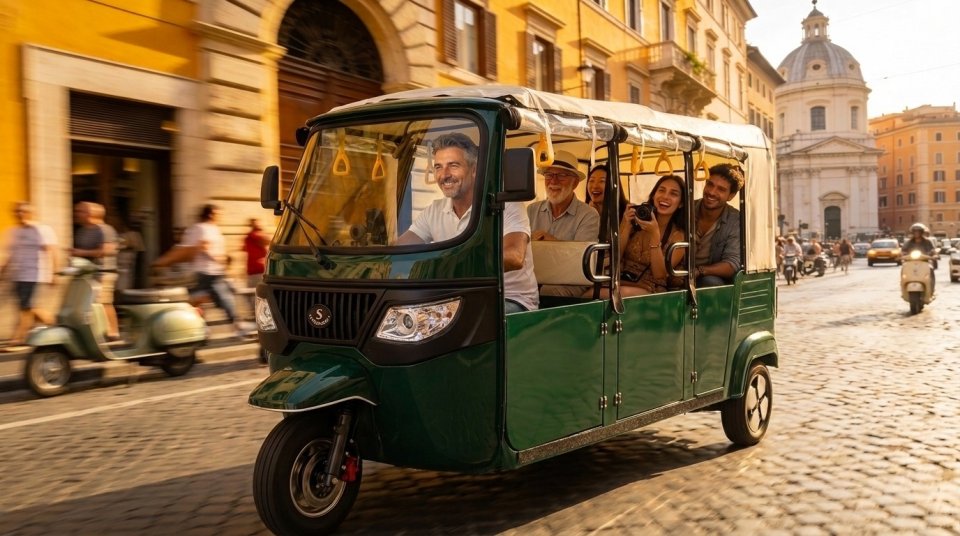
There's a clear difference between visiting Rome and living it. The first you know well: queues at monuments, restaurants with laminated menus and a photo of every dish, itineraries that every tourist follows in exactly the same way. The second is the one you won't find in any guidebook, because it depends on who accompanies you and how well that person truly knows the city.
A personal driver in Rome isn't a taxi driver with a few historical facts up their sleeve. They're someone who takes the effort of deciding off your hands — where to go, what to order, how to get around — and gives you back time. Time to use for looking, tasting, and stopping wherever you feel like it.
What "tailored" really means
The word gets overused in tourism. You hear it everywhere, but in practice it often means little more than a pre-packaged itinerary with your name on it.
A truly tailored experience has one simple quality: it changes based on you. If you're a couple looking for a slow evening between Trastevere and a good glass of wine, that's something different from an experience for a family with children who want to understand what Rome looks like beyond the tourist posters. Which is different again from a group of friends who want to eat well, without spending money in places that survive on tourists alone.
The starting point isn't the itinerary. It's the conversation that happens beforehand — understanding what you're looking for, how much time you have, what you actually enjoy.
The vehicle: why the tuk tuk changes everything
Getting around a city like Rome in a small, quiet, agile vehicle isn't an aesthetic detail. It's a choice that opens up possibilities a van or a bus simply don't have.
The electric tuk tuk fits into the alleyways of Trastevere where cars struggle to go. It stops wherever it likes, without blocking traffic and without creating that organised-group feeling that so often makes an experience feel artificial. It heads up to the Gianicolo at the right moment, crosses Testaccio without rushing, waits for sunset in exactly the right spot.
It makes no noise. It produces no emissions. And it's surprisingly comfortable.
What your itinerary can include
There's no fixed menu, but there are some experiences that come up again and again because they genuinely work.
Those who want to understand Roman food often start at the market: Testaccio, Campo de' Fiori, Trionfale. Not to shop, but to see how it all works. How produce is selected, who the long-standing vendors are, what people actually eat before they sit down at a table. From there, the natural next step is the kitchen — a cooking class where what you've seen becomes something you know how to make.
Those who prefer to keep moving and tasting choose the street food tour: supplì, pizza al taglio, frappe, maritozzi. Places with no neon signs and no tourist queues out front, selected because the quality is real and they don't coast on reputation.
Those who want to slow down choose the picnic: a carefully prepared basket, a panoramic location, and the time to enjoy it. The Gianicolo at sunset, a historic park, a corner of the city that most people never find.
Those who want to end the day on a precise note choose the wine tasting: wines from Lazio and beyond, in settings that make sense for what you're drinking.
All of this can be combined, extended, or scaled back. The standard duration is around one hour, but a full experience with market and cooking class runs up to three hours. You set the limit.
The driver's role: much more than a chauffeur
The person behind the wheel of the tuk tuk isn't there to get you from A to B. They're someone who knows the city well enough to know where it's worth stopping and where it isn't, which trattoria still cooks the way it should and which one is living off its name, when an alleyway is worth strolling through slowly and when it makes more sense to take another route.
This isn't a tour guide in the traditional sense — they don't recite dates and anecdotes from a script. They're someone who tells you about Rome the way they'd tell a friend: without filters, with a few opinions, with the knowledge of someone who lives there.
You can feel this difference. And it's usually what people remember most.
For those who have already seen Rome
There's a common misconception: that this kind of experience is only suited to people who already know Rome and want something different. In reality it works just as well for first-time visitors, because it changes the entry point. You don't start from the monument — you start from the city. And when you do go to the Colosseum or the Pantheon, you see them with different eyes. You already know how the surrounding neighbourhood works, you've already tasted something, you've already understood that Rome is far more than what appears on the postcards.
Private or group: the practical difference
The private tour is for those who don't want to compromise on pace. You stop where you like, set off again when you're ready, ask questions without waiting for everyone else to finish. It's the natural choice for couples, families, or anyone who wants an experience that is truly their own.
The group tour has a different dimension: sharing a discovery with other travellers adds something unexpected. A conversation, a perspective you wouldn't have had on your own. For those who are open to this, it can be just as rewarding.
How it all begins
There's nothing complicated about it: you book online, let us know if you have any particular needs — dietary requirements, preferences, things you want to see or avoid — and the departure point is confirmed at the time of booking.
If you're unsure what to choose, getting in touch before booking is the quickest way to find the right combination. Five minutes of conversation is worth more than any description on the website.


