


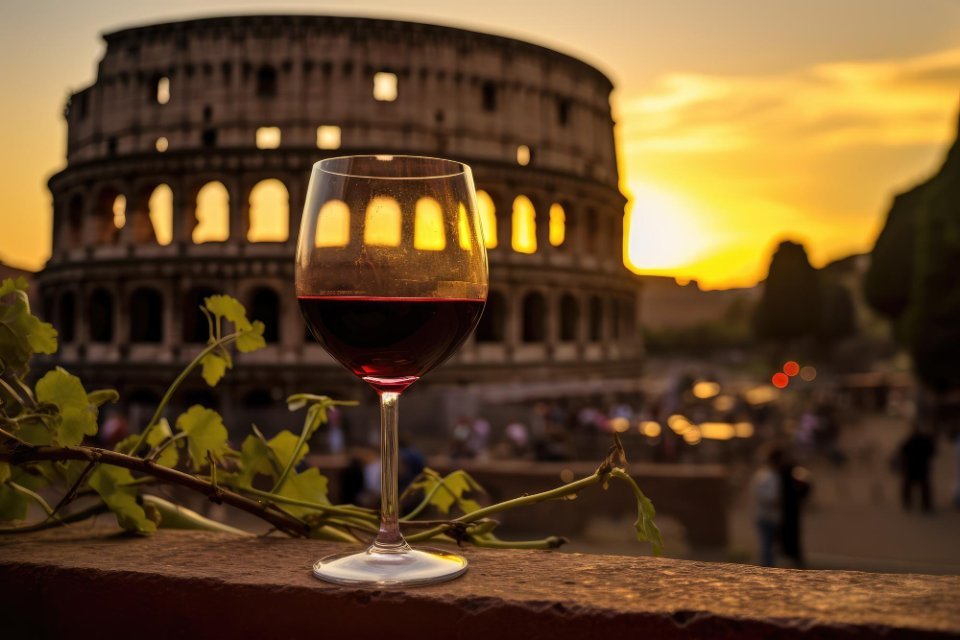
The ideal Roman evening is born from the meeting of a good glass of Lazio wine, an aperitivo built on typical local products and a close-up view of the monuments of the historic centre. The formula works because it combines three pleasures into a single experience: you sip a Frascati or a Cesanese while your gaze falls on a fountain, an arch or a bell tower, pairing each sip with supplì, pecorino romano and carciofi alla romana. The real secret, though, is not picking the bar closest to the monument — it is building a route that makes the glass and the stone speak to each other.
- Why wine, aperitivo and monuments work together in Rome
- The Lazio wines to order at aperitivo time
- The local food that pairs with the glass
- Matching the glass to the monument: the itinerary
- When and how to experience the evening
- Sources
Why wine, aperitivo and monuments work together in Rome
How do you create the perfect Roman evening around a glass, some bites and monumental beauty? In what way do wine, aperitivo and monuments blend into a single experience? Why does the aperitivo with a view of Rome's landmarks remain the city's most successful evening ritual? The answer is simple: in Rome the backdrop is already set. You do not need an expensive rooftop for a memorable setting — all it takes is a seat in one of the squares of the historic centre. The difference between an ordinary evening and an unforgettable one lies in consciously pairing the local wine with typical Roman food, letting the monument act as a frame rather than a mere photo opportunity.
The Lazio wines to order at aperitivo time
Lazio produces wines that are ideal for aperitivo: fresh, versatile and deeply rooted in the territory. For whites, go for Frascati Superiore DOCG, savoury and citrus-edged, a natural partner for fried bites. Look out also for Malvasia Puntinata, the indigenous grape of the Castelli Romani hills, rounder and more floral in character. On the red side, Cesanese del Piglio DOCG is the only red DOCG of Lazio: spiced and well-structured, it holds up beautifully against aged pecorino and cured meats. For sparkling options, a traditional-method sparkling wine from Lazio or a sparkling Frascati rounds out the picture. The guiding principle among Rome's top sommeliers is clear: the wine should come from the same land as the food. Drinking Lazio while eating Lazio is not folklore — it is gustatory coherence that amplifies both.
A Frascati alongside a supplì is not a tourist pairing: it is simply the way Rome has always eaten and drunk.
The local food that pairs with the glass
An authentic Roman aperitivo is not an anonymous buffet but a precise selection of typical products. The pillars: supplì al telefono (fried rice balls filled with ragù and stretchy mozzarella), Pecorino Romano DOP with a drizzle of honey, carciofi alla romana when in season, fried courgette flowers and mortadella or coppiette as part of a charcuterie board. For a contemporary twist without betraying tradition, the most forward-thinking venues now offer zero-kilometre boards featuring cheeses from the Roman countryside and artisan fermented drinks in place of industrial mixers. The real innovation in this space, the move that separates the top 0.1% of venues from the rest, is the growing use of rediscovered Lazio vermouths and bitters, cold-blended into cocktails that restore a genuine territorial identity to every sip.
Matching the glass to the monument: the itinerary
The best way to experience the connection between monuments and local food is to build a short itinerary of closely spaced stops through the historic centre. Start at Campo de' Fiori for the first glass among the evening market stalls, then walk to Piazza Navona to admire Bernini's Fountain of the Four Rivers over a charcuterie board. Cross the river into Trastevere, where the cobbled lanes and the Basilica of Santa Maria in Trastevere provide the ideal backdrop for a red wine and some fried bites. This progression — fresh white at the start, structured red towards the end of the evening — follows the same logic as a tasting menu guiding the palate course by course. The monument is not a distraction: it marks the passages.
When and how to experience the evening
The ideal moment is sunset, when the warm light ignites the travertine of the monuments and temperatures soften. In spring and autumn the historic centre is less crowded and outdoor tables are easier to secure. Book ahead at venues in Trastevere and the Rione Ponte: seats with a direct view go fast. A tip from those who know best: arrive early, claim your outdoor table and let the evening unfold without hurrying — the value here is not speed, it is the length of the experience.
Ready to live your Roman evening among wine, aperitivo and monuments? Build your own route through the heart of the historic centre, from Campo de' Fiori to Trastevere, and book your outdoor table in advance. Trastevere, with its medieval lanes and the Basilica of Santa Maria, remains the neighbourhood that best embodies this formula: authentic, pedestrian-friendly and surrounded by the monuments that have made Rome eternal.
Sources
- Regione Lazio & ARSIAL — Atlas of wines and typical agri-food products of Lazio
- Ministry of Agriculture, Food Sovereignty and Forestry (Italy) — Official register of DOP, IGP and DOCG/DOC wines of Lazio
- City of Rome & Sovrintendenza Capitolina ai Beni Culturali — Fact sheets on monuments of the historic centre
- UNESCO World Heritage Centre — Historic Centre of Rome, World Heritage Site


