


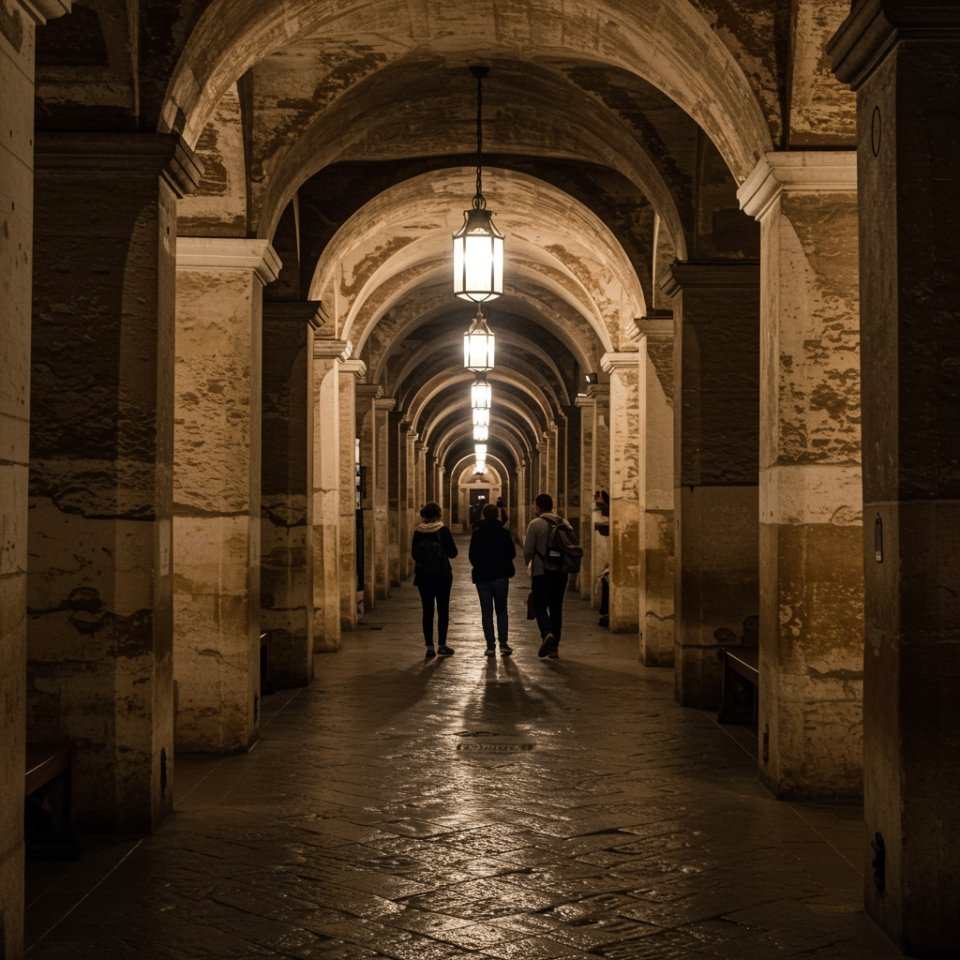
"Rome was not built in a day, but every day Rome continues to build itself."
There are cities that let themselves be looked at. And then there's Rome, which instead lets itself be discovered. Layer by layer. Like a thousand-year-old cake in which every bite reveals flavours you didn't expect, scents you can't name, emotions you didn't think you could still feel.
When you walk across the worn cobblestones of a Roman piazza, you're treading on three thousand years of living history. Beneath your feet, just a few metres down, a world beats that most tourists will never see. A world that waits, patient and silent, in the darkness.
This is Rome's greatest secret: its most intense life is not on the surface.
Beneath the Colosseum: where the lions waited for their moment
Go down. Let your eyes adjust to the half-light. You're in the hypogeum of the Colosseum — the belly of the beast.
Here, where the organised chaos of beasts and gladiators once reigned, the air has a different weight. An ancient weight. You can almost hear the muffled roar of sixty thousand spectators above your head, the creak of the hydraulic traps that lifted men and animals up towards the blinding light of the arena.
"Panem et circenses" — said Juvenal with bitter irony. Bread and circuses. But descending here, into the stone womb of the Colosseum, you understand that phrase wasn't just political criticism. It was the description of an entire civilisation that had turned life and death into spectacle.
When you come back up, the light of Rome hits you differently. As if you've understood something that had escaped you before.
Beneath San Clemente: three churches, three civilisations, one single shiver
"Rome is the only city in the world where one can get lost in time, not just in space."
The Basilica of San Clemente, not far from the Colosseum, appears on the surface to be a medieval church like many others. Beautiful, sober, ornate. But if you accept the invitation of the staircase that descends, something extraordinary happens.
You arrive at a second church, from the fourth century, buried beneath the first. The mosaics are still there, fixed in time, their colours faded but stubborn. Then you go down again. And you find a temple of Mithras — the solar god of the Roman legionaries — with its altar and ritual basins. Below that there is even an underground stream that still flows today, after two thousand years, with the same light and indifferent sound of water that knows nothing of us.
Three civilisations layered one on top of the other, three ways of believing, building, and hoping. All still there, alive in the dark.
Few places in the world make you feel so small — and so extraordinarily part of something immense.
Beneath Piazza Navona: the breath of Domitian's stadium
Rome's most beautiful piazza has a secret that few people know: its elongated shape, so different from all the others, is no accident. It is the memory of a first-century Roman stadium — the Stadium of Domitian — that could hold thirty thousand people.
You can go down to visit its remains. You walk between the travertine arches, trace the curve of the terracing, feel the vast proportions of an architecture designed to astonish. And while you're down there, life carries on above you: tourists, street artists, children running, gelato eaten on the go.
Two worlds separated by a few metres of stone and two thousand years of history.
"No place is more moving than one where life has never stopped" — and Rome is exactly that: a city that has never ceased to live above its own ruins.
Beneath the Church of Santi Giovanni e Paolo: the home of those who chose to die for what they believed
Less well known, more intimate, perhaps for that reason even more moving. On the Celio hill, behind the Colosseum, beneath the Basilica of Santi Giovanni e Paolo, twenty rooms of a second- to third-century Roman insula open up. Apartments, shops, a frescoed nymphaeum, corridors where scenes of everyday life can still be read on the painted walls.
Here lived, and here were martyred, two officers of the imperial court who refused to sacrifice to the gods. History tells us that their bones still rest beneath the altar, above the heads of those who never know.
To descend into these rooms is like opening a door and finding someone who was waiting for you.
The tour as a reason to truly understand Rome
There is a way of seeing Rome that leaves a mark, and a way that leaves only a selfie in front of a monument.
The difference doesn't lie in what you look at. It lies in how you look at it. In who tells you what lies beneath. In how far you're willing to go down — literally and metaphorically — into this bottomless city.
"Rome cannot be explained, it must be lived" — and living it means accepting that every corner you think you know hides something you haven't yet seen. It means letting a passionate guide take you by the hand and lead you where mass tourism never reaches. It means finding yourself underground, in silence, with the distant noise of the city above, and finally understanding why everyone who comes to Rome can never quite stop thinking about it.
Because Rome never truly lets you go. Not even when you go home.
Especially if you've had the courage — and the good fortune — to discover what lies beneath.


