


Rome has over nine hundred churches. Nine hundred. Yet most visitors see two, maybe three — the ones that appear in every guidebook, every suggested itinerary, every Instagram post with the most-clicked geotags. St Peter's, the Pantheon, Santa Maria Maggiore. Beautiful, of course. But Rome hides something rarer: places of worship that have kept centuries of history in silence, often just a few metres from the most well-trodden tourist routes, invisible to those who don't know where to look.
This article is for those who want to look further.
Why Rome's lesser-known churches are often the most extraordinary
There's a curious paradox in Rome's religious tourism: the more famous a church is, the harder it is to truly experience it. Queues, organised groups, camera flashes, audio guides in six languages all playing at once. The atmosphere dissolves.
The lesser-known churches, on the other hand, have something the great ones have lost: silence. You walk in, and you feel the weight of centuries in a physical way. You don't look at the mosaics from behind a barrier — you stand right in front of them, up close, with no one pushing you from behind. The light enters in a precise way, just as the architects of a thousand years ago calculated it would. And often it's just you, and that place.
Santa Maria in Cosmedin: the Mouth of Truth hides a greater treasure
Almost everyone knows the Mouth of Truth — that marble mask under the portico that has had a queue in front of it for decades. Few people stop to look at what's inside the church. Yet Santa Maria in Cosmedin is one of the jewels of medieval Rome: an original twelfth-century Cosmatesque floor, one of the finest Gothic ciboria in the city, frescoes that tell forgotten stories. The church was built over an ancient Roman structure, and the layering of the ages is still readable in the foundations and columns.
It's worth arriving early in the morning, before the queue at the mask begins to form. Ten minutes inside will change your perspective on what it truly means to "see Rome."
San Giovanni a Porta Latina: time has stood still here
Outside the city walls, along one of the oldest consular roads, this fifth-century basilica seems to have survived by a miracle. The Romanesque portico, the cloister with its monumental cedar tree said to be a thousand years old, the bare and authentic interior: nothing here was built for tourism, because tourists almost never come.
The few people who visit usually end up here by chance, strolling towards the Aurelian Walls. And it's exactly the kind of discovery that stays with you.
Santi Quattro Coronati: the courtyard no one expects
In the Celio neighbourhood, just a few minutes from the Colosseum, this Benedictine monastic complex feels like another city entirely. The heavy portal, the first open-air courtyard, the second courtyard even quieter than the first, the Chapel of San Silvestro with its thirteenth-century frescoes among the best preserved in all of Rome. The nuns of the monastery open the chapel for you through a revolving hatch, hand you a coin for the lighting, and leave you alone with something extraordinary.
All of this exists a five-minute walk from the most photographed arena in the world.
Santa Prassede: the mosaics that take your breath away
This church, in the Esquilino neighbourhood, is known among art historians as one of the most important mosaic sites in Italy. For some incomprehensible reason, it almost never appears in general travel guides. The Chapel of San Zeno — known as "the Garden of Paradise" for the quality of its ninth-century Byzantine mosaics — is a tiny space covered almost entirely in gold and coloured tesserae. The light that filters through reflects differently depending on the time of day. Every visit is literally unique.
The main nave and the apse are no less impressive: the scene of Paradise with Christ in glory is among the most powerful representations in Roman medieval sacred art.
San Clemente: three cities in one
Technically San Clemente is fairly well known, but very few visitors go all the way down — and the bottom, here, means going back two thousand years. The current church dates from the twelfth century. Below it lies a fourth-century Early Christian basilica. Below that is a first- to second-century Roman mithraeum, with a stream that still flows today beneath the foundations. Three overlapping eras, reachable by descending a staircase, while the modern city carries on above you, unaware.
It is one of the most extraordinary places not only in Rome, but in the entire ancient world. And you'll often find yourself there among very few others.
How to truly experience them: the tuk tuk as a key
The challenge with these places isn't finding them — with the right address you can get there. The challenge is context: without someone to explain what you're looking at, you risk missing ninety percent of what's in front of you.
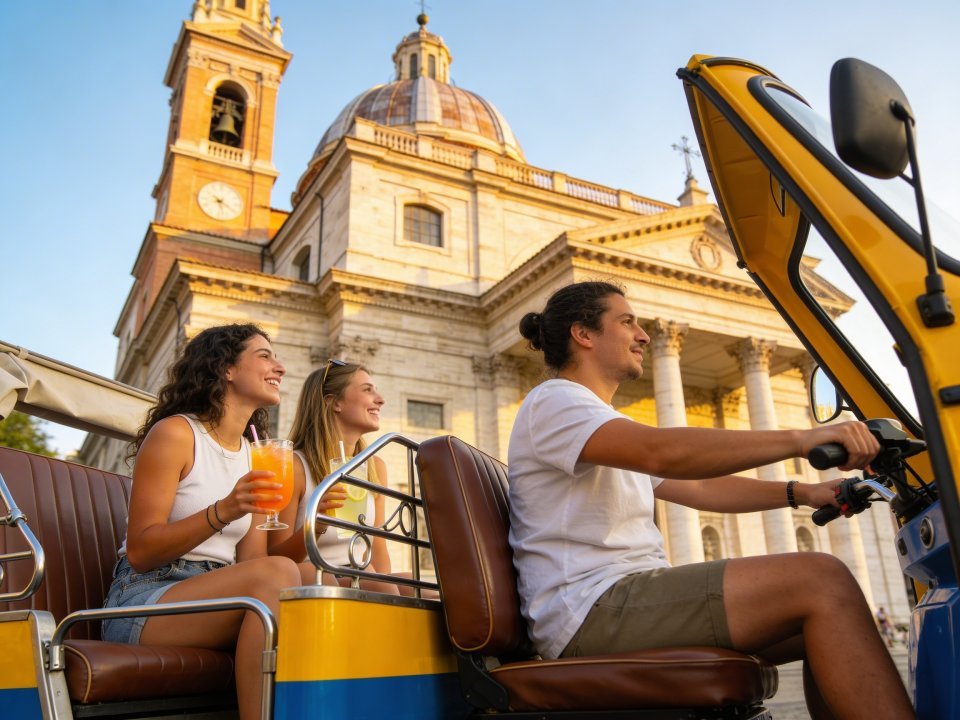
A tuk tuk tour dedicated to Rome's lesser-known churches solves both problems: the vehicle takes you where you otherwise wouldn't go, and the guide gives you the tools to understand what you're seeing. Not dates and textbook facts — stories. Because every church has a story worth hearing.
Travelling by electric tuk tuk through the Celio, the Aventino and the Esquilino — the hills where many of these places are concentrated — also has a practical value: these are areas with steep streets and narrow lanes that become tiring on foot, especially in the warmer months.
Silence as a luxury
There's one thing all the churches on this list have in common: you can be there in peace. No obligation to move at the group's pace, no audio guide drowning out your own thoughts. Just you, the history, and that particular quality of light that Rome reserves for the places it has decided to keep for itself.
In a city that welcomes tens of millions of tourists every year, finding silence and authenticity has become almost an act of searching. But it can be done, if you know where to go.
Before you visit: a few practical tips
Many of the less-visited churches have limited opening hours — they often close at midday and reopen in the afternoon. Some, like Santi Quattro Coronati, ask for a small offering to access their most beautiful sections. Bringing a torch or turning on your phone's light can make a real difference in poorly lit spaces. And of course, respect the silence: these are active places of worship, not museums.
The best time to visit is early in the morning or late afternoon, when the light is warm and the crowds are thin.
Rome always has more to show than it lets on. You just need to know where to look — and have someone to point you in the right direction.


